Ca a Water Softener Improve the Taste of Tap Water?
Half the calls I get about taste start the same way. Somebody comes back from a week at their sister’s place, pours a glass at home, and suddenly notices what they’ve been drinking for eleven years. Chalky. A little metallic. Something. Then they ask me whether a softener will improve the taste. Sometimes it will. Depends what you’re tasting.
What Hard Water Tastes Like
Calcium and magnesium that’s all hardness is. Minerals the groundwater picked up moving through rock long before it got anywhere near your house. Nothing dangerous about them. They just sit on your tongue.
Some people call it chalky, some say bitter, and most people say nothing at all. That’s where the arguments start. I was in a kitchen off Kirkwood Highway a while back where the wife wouldn’t drink from the tap and the husband figured she was inventing it. He wasn’t being difficult. He honestly couldn’t taste it. Sensitivity to minerals varies more than folks expect, and you won’t settle that one by arguing.
Plain version: if minerals aren’t your problem, softening won’t improve the taste at all. You’ll get better lather and the same bad glass of water.
What a Softener Actually Does
Your water runs through a tank of resin beads, the beads grab the calcium and magnesium and hand back sodium, and once a week the unit flushes itself with brine and starts over. That’s the whole trick.
What you notice first isn’t taste. Soap lathers instead of curdling into gray film. Mineral buildup on the showerhead slows way down. The water heater quits packing scale onto the element the kind of thing that costs you quietly for six years, then all at once.
Flavor is less predictable. If chalk was the complaint, softened water can improve the taste inside of a day. If you’re a sensitive taster, you might pick up a slickness from the sodium. Mild, usually. Some folks never take to it and end up with a small filter under the kitchen sink just for drinking. That’s not a failure. That’s just how it shook out.
Figuring Out What You’re Actually Tasting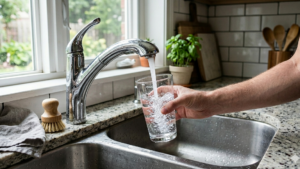
Metallic usually means metal. Copper lines, an old galvanized run nobody ever replaced, iron if you’re on a well. Chlorine tastes like a swimming pool in August and comes straight from municipal treatment doing exactly what it’s supposed to. Rotten egg is sulfur.
That last one has a tell. If you only smell it in hot water, stop looking at the whole house and go look at the water heater’s anode rod. Had a guy over near Paper Mill Road ready to write a check for a whole-house system. It was the rod. Forty-five minutes, and he bought me a coffee.
Test the water before you buy anything. Hardness and iron are the two numbers that decide most of it. Guessing is how people spend three grand and don’t improve the taste by a nickel.
When You Need Both a Softener and a Filter
Plenty of Newark homes do. A water softener handles hardness. Carbon handles chlorine and the flavor riding along with it. Two different tools, and neither one covers for the other.
Order matters. Sediment prefilter, then the softener, then carbon on the drinking line. Run it backwards and you’ll chew through resin for nothing.
Here’s what gets skipped on DIY installs: the drain line has to discharge through an air gap so backwash can’t siphon back toward your drinking water. That’s code, not preference, and Newark expects this work permitted and inspected. On a normal basement with a drain and an outlet close by, I’m in and out in three to four hours. Add a couple more if there’s no loop and I’m plumbing one from scratch. Set up right, the pair will improve the taste and knock down mineral buildup at the same time.
Start With a Test, Not a Catalog
Waiting doesn’t make this cheaper. Scale keeps building on your heater whether or not you’ve settled the flavor question, and a softener plumbed without an air gap is a cross-connection sitting in your basement. Want to improve the taste? Get the water tested, then decide. Call Boulden Brothers in Newark. You call. We come. It’s fixed.
FAQ
So will it actually make my water taste better or not?
If hardness is what you’re tasting, yes pulling out the calcium and magnesium can improve the taste noticeably. If your complaint is chlorine or sulfur, softening won’t touch it. A test tells you which camp you’re in.
Does it get rid of the chlorine smell?
No. Softeners go after hardness minerals, not disinfectant. You want activated carbon for chlorine whole-house if it bothers you in the shower, or a small point-of-use filter if you only care about the drinking glass.
Is softened water safe if I’m watching my sodium?
For most people, yes. The amount added tracks with how hard your water started out, so harder water means a little more. On a restricted diet, ask about potassium chloride or leaving one unsoftened line to the kitchen tap.
Mine tastes salty now. Is that just how it is?
No, and don’t let anybody tell you it is. A correctly sized unit running correctly shouldn’t taste like the ocean. Salty usually means it’s over-regenerating or a valve’s hung open. Have somebody look at it.
Can’t you just taste it and tell me what’s wrong?
I can guess, and I’m right more often than not. But a test gives you hardness in grains and iron in parts per million, which is what sizing actually runs on. It also tells you when no softener will improve the taste and something else will.
Test first, buy second. Most of the water I taste around Newark isn’t complicated it’s just been misdiagnosed by somebody with equipment to sell.