Smoke Detectors and Smart Home Systems
There’s a moment most homeowners recognize, standing in the kitchen, waving a dish towel at a screaming smoke alarm because the toast burned. The detector did its job. But that’s roughly where the usefulness of a traditional smoke alarm ends. No alert to your phone. No camera turning on. Just a loud beep until the air clears.
That’s why more people are asking whether smoke detectors can be paired with smart home systems. The short answer is yes. The longer answer is worth understanding before anyone starts swapping hardware or downloading apps.
What It Means for a Detector to Be Paired With Your Home System
A smoke detector that’s paired with a smart home platform stops acting as a standalone device. It becomes part of a connected system that shares information and triggers responses across the house.
When smoke is detected, an integrated alarm can simultaneously send a phone notification, switch smart lights to full brightness, shut down the HVAC so smoke doesn’t spread through the ducts, start recording on interior cameras, and in monitored setups, contact emergency services.
That coordination happens in seconds. A basic smoke alarm, no matter how loud, can’t do any of that.
Two Ways Detectors Get Paired
Most installations fall into one of two categories.
Smart Smoke Detectors Built for Connectivity
Brands like Nest, Kidde, and First Alert make detectors built to connect directly to smart home platforms. They support Wi-Fi, send push notifications, deliver voice alerts that identify the specific location (“smoke detected in the kitchen”), and can be paired with ecosystems like Google Home, Apple Home, or Amazon Alexa.
Setup is usually manageable. The trade-off is cost these units run significantly higher than a standard detector, and in a larger home, that adds up quickly.
Integrating Existing Hardwired Detectors
This approach works well in homes that already have interconnected hardwired alarms. Instead of replacing every detector, an installer adds a smart relay module that listens for an alarm signal and passes it to the smart home platform. The existing detectors stay in place. The relay handles the communication layer.
It’s often the more practical option. Hardwired systems are already interconnected, which means when one goes off, all of them do. Adding smart alerting on top of that infrastructure is a reasonable step without a full hardware replacement.
Where Being Paired Adds the Most Value
The practical value of a detector paired with a broader home system becomes obvious in situations where no one is home or where sleeping through an alarm is a real risk.
A homeowner with a rental property two hours away gets a notification the moment a detector triggers. Someone traveling for work knows within seconds if something’s happening at home. At 3 AM, when a smoke alarm sounds in the bedroom, paired smart lights turning on throughout the house immediately can make a real difference in response time not in a theoretical way, but in the kind of way that affects outcomes.
The coordination between a detector paired with cameras, locks, and lighting is what separates a loud beep from a system that actually responds.
Reliability Comes First
Smart integration gets added to smoke detectors, not substituted for them.
That point matters more than it might seem. The detector itself still has to function as a standalone life-safety device. If Wi-Fi drops, if the hub goes offline, if an app update causes a glitch the alarm still needs to go off. Building codes don’t recognize smart features. They require working smoke detection, full stop.
There are homes where someone has swapped properly installed interconnected hardwired alarms for cheap battery-powered Wi-Fi units because they liked the app. That’s a bad trade. The smart layer is only worth having if the underlying detection is solid.
Installation Is Rarely as Simple as the Box Suggests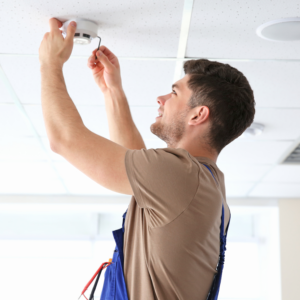
Some product marketing suggests that getting detectors paired with a smart system takes five minutes. Sometimes it does. More often, there’s more involved.
Linking devices to a hub, pairing them with automation routines, checking firmware, sorting out Wi-Fi dead zones near the detector location these aren’t impossible tasks, but they require some experience to get right. Older homes with non-standard wiring add another layer. Relay modules sometimes need configuration that isn’t covered in the quick-start guide.
Getting it right the first time matters more with safety equipment than with smart lighting.
FAQ’s – Paired Smoke Detection
Can existing hardwired smoke detectors be paired with a smart home system?
Often, yes. A smart relay module can connect existing hardwired alarms to a smart platform without replacing the detectors themselves. It listens for the alarm signal and routes it to the system.
If the internet goes down, does the detector still work?
It does. The detector operates independently of any network connection. Losing Wi-Fi means losing remote alerts, but the alarm still sounds locally as it always would.
What other devices can a smoke detector trigger when it’s paired with a smart system?
Lights, cameras, HVAC systems, and smart locks are common. In monitored setups, emergency services can be notified automatically. The specific triggers depend on the platform and how automations are configured.
Are smart smoke detectors required by code?
No. Building codes require functional smoke detection that meets fire safety standards. Smart features are optional. The detector has to perform correctly as a life-safety device regardless of whether it’s paired with anything else.
Is it worth the cost to integrate existing detectors rather than replacing them?
Usually, yes especially in homes with newer hardwired interconnected systems already installed. Adding a relay module is typically cheaper than replacing every detector with a smart unit, and the performance difference is minimal for most homeowners.
The most useful way to think about a smoke detector paired with a smart home system is as a communication upgrade. The detection itself doesn’t change. What changes is what happens next who gets notified, what else turns on, how fast a response begins. For most people, that added layer earns its place quickly.