Do Smoke Detectors Have To Be In Every Bedroom?
Close a bedroom door, start a smoke machine down the hall, and watch how long it takes for the alarm to trigger inside that room. Sometimes several minutes pass. That’s enough time for a real fire to become a life-threatening one. It’s also why code requirements shifted the way they did.
Short answer: Yes, smoke detectors are required in every bedroom under most current building codes. Here’s what that actually means in practice.
What the Code Requires
Across the U.S., the standard requirement covers three locations:
- Inside bedrooms
- Outside sleeping areas, typically the hallway
- On every level of the home
A two-story house with three bedrooms might need six or seven detectors once you account for all the levels and common areas. That number surprises people, but the layout logic is straightforward. The goal is coverage, not just somewhere in the house, but close enough to wake you up before the situation is already out of hand.
State and local codes vary, but the bedroom requirement appears in nearly all of them at this point. For new construction and major remodels, inspectors check for it. No alarm in a sleeping room, no sign-off on the permit.
Why Bedrooms Specifically
Most house fires that turn deadly happen at night. People are asleep, doors are closed, and a hallway alarm even a loud one can be muffled enough that someone sleeping behind a closed door won’t hear it in time.
This isn’t theoretical. A family whose teenager slept through a hallway alarm during a small kitchen fire is a real example. Parents heard it immediately. The teenager, with a fan running and the door shut, barely registered it. After a unit was added in the room and the interconnected system was tested, the difference was obvious. Every alarm in the house fired at once.
Older Homes: A Different Set of Rules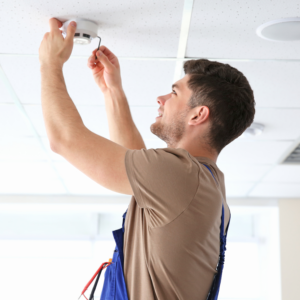
Homes built before current codes took effect fall under what’s generally called “existing conditions.” You’re legally allowed to keep whatever was installed when the house was built which in many cases means detectors only in hallways.
So no, if you’ve lived in a 1975 ranch house for twenty years, you’re probably not legally required to add alarms to every bedroom. But here’s the practical reality: a detector costs twenty to thirty dollars. The code debate isn’t worth more time than it takes to drill two screws and snap one in.
If you’re finishing a basement, converting a room, or pulling any kind of permit for an addition, that changes things. New sleeping areas require detectors before final approval.
Hardwired vs. Battery in Bedrooms
New construction today almost always requires interconnected, hardwired smoke alarms with battery backup. Hardwired means they run off the home’s electrical system. Battery backup means they still function during a power outage. Interconnected means when one goes off, every unit in the house goes off simultaneously.
Bedroom alarms in new builds are part of that system not optional additions.
In an older home where you’re adding coverage yourself, battery-only units are acceptable. They’re not connected to the rest of the system, which is a real limitation, but having a detector inside the bedroom still matters more than having nothing there at all.
Placement Within the Room
Ceiling mounting is standard. Smoke rises, so a ceiling unit near the center of the room catches it faster. If ceiling mounting isn’t workable, wall placement is allowed, ideally within 12 inches of the ceiling.
Avoid corners, the area directly above or near air vents, and anywhere within a few feet of a bathroom. Steam from a shower will trigger false alarms, and a detector that cries wolf gets removed. That’s a worse outcome than a slightly suboptimal placement.
Rental Properties
Landlords in most states are legally required to provide working smoke detectors, including in bedrooms. The rules vary by state, but rental housing typically faces stricter inspection than owner-occupied properties. Inspectors check for bedroom coverage before new tenants move in. Missing units have to be corrected before the keys change hands.
Tenants are generally responsible for battery replacement unless the unit has a sealed ten-year battery, in which case the landlord typically handles it.
FAQ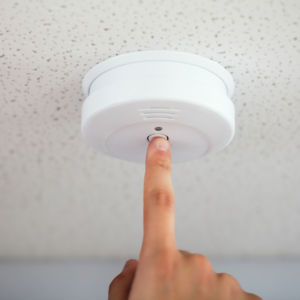
Are smoke detectors required in every bedroom, or just outside them?
Both. The current code requires a detector in each bedroom and in the hallway outside the sleeping areas. One in the hall doesn’t cover the bedroom.
My house was built in the 1980s. Am I required to add bedroom alarms?
If you’re not remodeling or pulling permits, probably not legally. Practically speaking, it’s worth doing anyway given the low cost.
Can I use battery detectors in bedrooms instead of hardwired ones?
In existing homes, yes. Battery units are acceptable for retrofitting. New construction typically requires hardwired interconnected alarms.
How many smoke detectors does a house actually need?
At minimum: one per bedroom, one outside sleeping areas, one per level. A larger or multi-story home will need more, depending on the layout.
Where’s the worst place to put a bedroom smoke detector?
Near a bathroom. Steam from showers consistently causes false alarms, which leads people to remove or disable the unit. High on the wall or centered on the ceiling, away from vents and fans, is the right call.
Do combination smoke and CO detectors work for bedroom requirements?
In most jurisdictions, yes. A combination unit counts toward both requirements, which can simplify installation in bedrooms where both alarms are needed.
The one thing worth repeating: a detector inside the bedroom is fundamentally different from one down the hall. The closed-door problem is real. A few minutes of delay in a smoke situation is not recoverable time. That’s the reason the rule exists, and it’s a good one.