Can Nearby Lightning Damage Your Home?
Storm rolls through Newark around dinnertime. Power blinks once. Nobody thinks much of it. Then the AC won’t start, the garage door opener is dead, and there’s not a mark on the roof or a split tree in the yard. That’s the call I get all summer, and the answer is usually the same: nearby lightning did it from a block or two away.
How a Strike Down the Block Gets Inside Your House
Lightning dumps a staggering amount of energy into whatever it hits, and that energy looks for somewhere to go. Some of it rides the utility conductors. Some of it lifts the voltage of the earth itself for a few microseconds, which is how a strike into a soggy backyard pushes current up through a grounding electrode and into a panel.
Inside the city limits, homes are fed by Newark’s own municipal electric department, and plenty of the older sections still run overhead distribution. Overhead lines collect surges better than buried ones do.
Buried service isn’t a free pass, though. Coax comes in from outside too. So does phone, and the low-voltage run out to a doorbell camera. Nearby lightning takes whichever door happens to be open.
The Failure That Shows Up Three Weeks Later
Some equipment dies during the storm. Easy call, easy diagnosis.
The frustrating ones are the parts that get cooked partway and keep limping along. A homeowner over in Brookside had a storm come through in July, ran the AC fine the rest of the month, then called in mid-August because the system was short-cycling. Control board was scorched on the underside where nobody would spot it without pulling the access panel.
I can usually tell you what failed inside 45 minutes to an hour and a half. What I can’t always tell you is whether the storm caused it. A twelve-year-old capacitor was going to quit anyway, and nearby lightning makes a convenient scapegoat. Sometimes it’s the storm, sometimes it’s age, and once in a while it’s both.
What Surge Protection Actually Buys You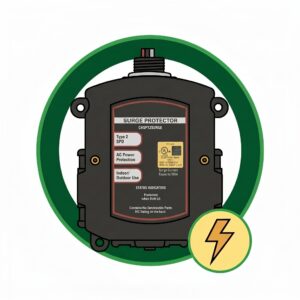
The strip under your desk protects what’s plugged into it. That’s the entire scope. It does nothing for the furnace, the well pump, or the range.
A whole-home device a Type 2 SPD landed at the main panel clamps the surge before it spreads across every circuit in the house. That’s the layer most Newark homes are missing, and it’s the one that matters when nearby lightning comes down the line. Newer construction shouldn’t be missing it, since NEC 230.67 has required surge protection on dwelling services since the 2020 code cycle, and panel work here needs a permit and an inspection regardless.
No SPD is a force field, though. Take a direct hit to the structure and the numbers stop meaning much.
Grounding Is the Part Nobody Checks
An SPD is only as good as the path it shunts energy into. If the grounding electrode conductor is loose at the rod, or the clamp has corroded down to a nub, that surge has nowhere clean to go and starts hunting for a route through your equipment instead.
A lot of the postwar houses around Newark still have a single driven rod and a bonding jumper on a water line that got swapped to PVC sometime in the nineties. Nobody noticed. Grounding faults don’t announce themselves lights work, outlets work, everything looks fine right up until a big electrical event. Nearby lightning is usually the event that finds the flaw.
That’s not something you’re expected to catch on a Saturday. It takes a meter and somebody who knows what reading is acceptable.
Don’t Wait Out the Next Storm
Resetting a breaker over and over after a storm doesn’t fix a compromised board. It just puts more heat into something that’s already hurt. If your electrical started acting strange after that last round of storms, get eyes on it before the next one rolls in. You call. We come. It’s fixed.
FAQ
Can lightning mess up my house if it hit my neighbor’s yard?
Yes, and that’s the more common version of it a direct hit on your own roof is rarer than the surge that arrives from next door. Nearby lightning spreads through shared utility lines, coax, and the ground between the two properties. The damage depends on distance and which path it found.
Why did my AC quit the day after the storm instead of during it?
Surge stress doesn’t always kill a part outright. A weakened capacitor or control board can run for hours or weeks before it gives up. That’s why a tech should test components instead of assuming nearby lightning is the culprit.
Does homeowners insurance cover this?
Most Delaware policies include lightning coverage, but deductibles and documentation rules vary. Photograph the damage before anything gets hauled to the curb, and hang onto the diagnostic write-up. Adjusters want a professional’s account of what failed, not a homeowner’s best guess.
Should I be unplugging stuff when a storm’s coming?
For sensitive electronics, sure if you do it before the storm arrives. Don’t go yanking cords while it’s already cracking overhead. And it does nothing for hardwired equipment, the furnace and the condenser stay connected either way.
Is whole-home surge protection worth it in Newark?
For most homes here, yes. Summer storm season on this side of Delaware is active enough that nearby lightning is routine rather than rare. Surges also come from utility switching, so the device earns its keep in calm weather too.
If something’s been acting off since the storm, don’t wait it out. That’s how a repair turns into a replacement.