
Newark homeowners call me for a lot of reasons, but the scary ones usually start small, a tiny zap off the dishwasher, an outlet that’s been buzzing for months, a kid who touched a lamp cord and yelped. Most people shrug it off. I don’t. Small shocks are usually your grounding system waving a flag, not just bad luck.
What Grounding Actually Does
Picture electricity like water looking for the fastest way downhill. A grounding system gives stray current a direct path back to earth instead of through a person, an appliance case, or a metal pipe.
When a hot wire touches something it shouldn’t inside your dryer or your kid’s gaming console, that ground wire carries the fault current away before it builds up somewhere you’d touch. No ground path, and that current just sits there waiting. That’s when shocks happen not because electricity is unpredictable, but because it has nowhere else to go.
Why This Matters More With Kids in the House
A lot of Newark’s housing stock dates back to the 1950s and 60s, well before modern grounding requirements were standard, and I still run into plenty of those original two-prong outlets that never got upgraded. Add a toddler chewing a charging cable or a teenager running three gaming systems off one strip, and the odds of contact go up fast.
Grounding doesn’t stop every mistake, but it gives you a safety net when one happens. Bathrooms, kitchens, laundry rooms, garages, and anywhere water and outlets share space deserve extra attention, since moisture makes shocks more dangerous, not less.
Signs Your Grounding Might Be Failing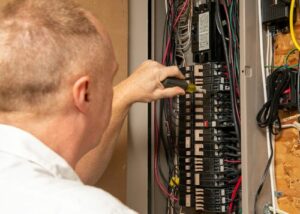
A homeowner over on Elkton Road called me last year because her toaster gave her a “weird tingle” every other morning. Turned out the outlet’s ground wire had corroded loose behind the wall, an easy fix once we found it, maybe 45 minutes start to finish.
Watch for warm switch plates, outlets that buzz, breakers that trip for no clear reason, or electronics that die early. Sometimes there’s no warning at all until an appliance fails inside. If something feels off, don’t wait for it to feel worse that’s usually how small shocks turn into real ones.
How Grounding and GFCI Protection Work Together
People assume the breaker does all the work. It doesn’t. It relies on a solid ground path to react fast. Say a hot wire touches the metal frame inside your dishwasher. With proper grounding, fault current races back through that wire and trips the breaker almost instantly.
Without it, current can sit on the metal case until someone touches it. GFCI outlets add another layer, cutting power the moment they sense a small imbalance, which is why code requires them in bathrooms, kitchens, and outdoor outlets. One system doesn’t replace the other when it comes to preventing shocks.
If your Newark home still has two-prong outlets, unexplained breaker trips, or an outlet that’s given someone a shock, don’t wait on it. At Boulden Brothers, we test grounding systems properly instead of guessing, and we get it fixed right the first time because waiting usually just means a bigger repair, or worse.
Frequently Asked Questions
Can I just look at my outlets and tell if they’re grounded?
Not really. Three-prong outlets don’t guarantee a working ground path plenty of older Newark homes have three-prong outlets wired without one. An electrician needs testing equipment to confirm the system’s actually doing its job.
Is a little shock from an appliance really a big deal?
It can be. Small shocks usually mean current found a path it shouldn’t have, which points to a grounding or wiring issue. It’s worth having checked before it happens again or gets worse.
How old does a house have to be before grounding’s a concern?
Homes built before the 1960s are the usual suspects, especially in Newark’s older sections. But renovations and DIY work can create grounding gaps in newer homes too.
Isn’t grounding basically the same as surge protection?
No. Grounding gives fault current a safe path to travel, while surge protection guards your electronics against voltage spikes. You typically want both one doesn’t cover for the other.
How often should someone get this checked?
If your home’s a few decades old, went through a remodel, or you’ve noticed flickering lights, tripping breakers, or shocks from an outlet, that’s your signal to schedule an inspection.
Grounding’s the part of your house nobody thinks about until it saves someone. Keep it that way get it checked.