Is a Tripping Breaker a Bad Breaker?
Most of the time when I get this call, the person on the other end has already reset the breaker four or five times. It holds for a while, then the kitchen or a bedroom goes dark again. They want to know if they need a new breaker.
Sometimes they do. More often than not the tripping breaker is working fine and something else on the circuit is the problem, and that’s what you want to figure out before anyone replaces parts.
How Fast It Trips Tells You a Lot
If it trips the moment you flip it back on, even with everything on that circuit unplugged, there’s almost always a short somewhere. A hot wire is touching a neutral or ground, and the breaker is reacting the way it should.
If it holds for a while and then goes when something big turns on, like a space heater or a hair dryer, you’re probably looking at an overload. We get a lot of these in Newark in the fall, once people start running heaters in rooms that were wired for a lamp and a clock radio.
The random ones are harder. When a tripping breaker goes at odd times with no obvious cause, it takes actual testing to sort out.
When a Tripping Breaker Is Really a Wiring Problem
Last winter we had a call in Brookside Park, one of the ranch neighborhoods that went up in the mid-’50s. A bedroom circuit was tripping every few days with almost nothing plugged in. A handyman had already replaced the breaker, and it kept happening.
I started at the panel and worked down the circuit outlet by outlet. At the third one, the wire had worked loose from a push-in terminal on the back of the receptacle. It had been arcing long enough to discolor the plastic. It took about 45 minutes to find and ten to fix.
That’s typical for houses this age. Most have had electrical work done by several different people over the decades. Loose connections, damaged insulation, and buried junction boxes are what I find most, usually wherever someone added an outlet.
Signs the Breaker Itself Has Failed
Breakers do wear out, though less often than people expect. A bad breaker might feel warm at the handle or refuse to latch firmly. If it trips with every load on the circuit disconnected and the wiring tests clean, that points to the breaker too.
A fair number of homes built between the ’50s and the ’70s still have Federal Pacific Stab-Lok or Zinsco panels. The concern with those isn’t extra trips. It’s breakers that may not trip when they should. If I find one, I’ll usually recommend looking at the whole panel.
AFCI breakers are a separate case. Newer code requires them on most living-area circuits, and they can nuisance-trip on older motors, like a vacuum’s, even when the wiring is fine. We test the circuit before swapping one.
Can’t You Just Put In a Bigger Breaker?
This usually comes up with a tripping breaker on a 20-amp kitchen circuit that someone wants to bump up to 30. The answer is no, because the breaker is sized to protect the wire. Twelve-gauge copper is rated for 20 amps. A 30-amp breaker on that wire will stop the trips, but it’ll let the wire overheat inside the wall without shutting anything off.
As for doing it yourself, resetting a breaker once is fine. Taking the panel cover off is different, because the conductors coming in from the meter stay energized even with the main off. In Delaware, licensed electricians have their work inspected by a state-licensed inspection agency. Homeowners doing their own wiring need a state homeowner permit, with a plan review first.
Get the Cause Found First
If a tripping breaker continues to trip, the cause usually isn’t going away on its own, and a loose connection behind a wall gets worse the longer it runs. The electricians at Boulden Brothers handle breaker and fuse replacement throughout Newark, but we diagnose the circuit first so it’s fixed right the first time.
Common Questions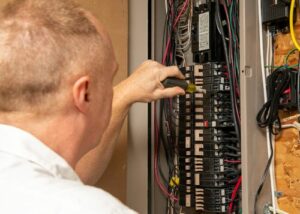
Why does my breaker only trip at night
Usually something on that circuit cycles on by itself, like a space heater on a thermostat or a dehumidifier. Make a note of what’s plugged in and roughly when it trips. That gives us a head start when we test it.
Is a tripping breaker dangerous
The trip itself is the breaker protecting the circuit, so that part’s working. The risk comes from resetting it over and over without finding the cause. If you smell something hot or see scorching at an outlet or the panel, leave it off and call.
How long does a breaker replacement take
Swapping the breaker is usually under an hour. Confirming it actually needs replacing can take longer, sometimes a couple of hours if the fault is intermittent. Most of the time on these calls goes into testing.
My tripping breaker goes off whenever my roommate uses her space heater, is the breaker bad
Probably not. Most space heaters draw around 1,500 watts, which is close to the limit of a 15-amp circuit on its own. We see this a lot in older Newark rentals near the University of Delaware, where one bedroom circuit often serves more than it was designed for.
Should I keep resetting a tripping breaker till someone gets here
Reset it once. If it trips again right away, leave it off and unplug everything on that circuit. Resetting into a short repeatedly can damage the breaker and whatever’s already failing. Leave it off tonight if you can, and we’ll take a look in the morning.