How Aeroseal Duct Sealing Can Help Your HVAC System

You can replace a furnace, upgrade a heat pump, install a smart thermostat and still have a house that heats unevenly, runs long cycles, and collects dust on every surface. The equipment isn’t the problem. The ducts are.
Most duct systems leak more than people expect. Not dramatically, not obviously just steadily, through dozens of small seams hidden inside walls and ceilings.
Conditioned air bleeds out before it reaches the room. The system compensates by running longer. And the homeowner keeps adjusting the thermostat, wondering why nothing’s working. That’s the situation Aeroseal duct sealing was built for.
What Aeroseal Duct Sealing Actually Does
The basic idea is straightforward, instead of accessing leaks from the outside, Aeroseal duct sealing, seals them from inside the duct system.
A technician connects a specialized machine to the air handler. All the registers get temporarily blocked so air can’t exit through the vents. The machine pressurizes the ducts and releases a mist of sealant particles into the airstream.
Those particles stay suspended until they reach a leak. When air pushes through a gap, the particles collect at the edges and build up gradually, layer by layer, until the opening closes. The monitoring system tracks leakage in real time, so there’s a live readout of the improvement as the process runs.
Most jobs wrap up in a few hours. The sealant cures flexible and stable, and it holds for years under normal conditions.
The Leaks You’d Never Find Otherwise
The gap between “looks fine” and “tests poorly” is wider than most homeowners realize.
A system can have clean joints, proper insulation, and no obvious damage and still lose 25 to 35 percent of its conditioned airflow through accumulated small leaks. Those losses happen in places nobody looks: duct runs inside finished walls, connections buried in tight attic spaces, seams that were never quite right even on new construction.
When ducts leak, the system pushes air into cavities that don’t need conditioning. Meanwhile, pressure differences pull unconditioned outside air in through other gaps. The result is a house that never quite reaches balance, certain rooms running warm, others cold, with equipment cycling constantly to compensate.
Fix the ducts, and the same system often performs dramatically differently. Not because anything mechanical changed, but because the airflow is finally going where it’s supposed to.
Aeroseal duct sealing makes that fix possible without cutting into finished walls or dismantling anything.
Where It Makes the Most Sense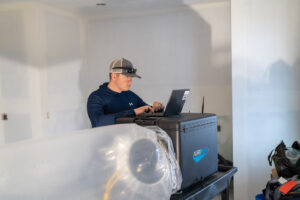
Not every duct situation calls for Aeroseal duct sealing technology. If ducts are exposed and accessible, traditional mastic sealing is still a solid approach. But when access gets difficult, ducts behind drywall, systems running through a tight attic, multi-story homes with long buried runs the math changes fast.
Physically accessing those leaks means drywall repairs, significant labor, and incomplete results, because you can never reach every seam. Aeroseal covers the entire system in a single run, including leaks that would be impossible to find manually.
It also works well as a quality measure on new construction. Even well-installed duct systems carry small gaps that add up. Running an Aeroseal duct sealing treatment before a home is occupied catches those issues before they affect comfort or efficiency for years.
A Two-Story House That Kept Running Warm
A homeowner had already replaced the AC unit on a two-story house where the upstairs stayed hot through the summer. The new equipment didn’t fix it. The complaint was the same.
Duct testing showed heavy leakage throughout a cramped attic space not the kind anyone wanted to crawl through with mastic and tape. An Aeroseal duct sealing treatment ran instead. Leakage dropped by more than half within the first hour, and by the end of the process it was a fraction of the original reading.
The homeowner called a week later and said the upstairs felt normal for the first time. Thermostat untouched. That’s a typical pattern. The equipment was never the problem.
FAQ
Does the sealant get into the living space?

No. The registers are blocked during the treatment, so sealant particles stay inside the duct system throughout the process. By the time the vents are reopened, everything has already attached to the leak points.
How large a leak can Aeroseal duct sealing handle?
It works well on small to medium gaps, seams, pinholes, loose connections, and aged joints. If there’s a significant break in the duct line, that section needs a physical repair first. Aeroseal handles what’s left.
How long does the sealing hold?
The cured material is stable and flexible. Under normal operating conditions, it lasts many years without reapplication.
What kind of improvement can I expect?
Leakage reductions of 70 to 90 percent are common. The effect on comfort is usually noticeable within the first few days rooms that were always off-temperature tend to stabilize, and run times typically drop.
Is the equipment protected during the process?
Yes. Sensitive HVAC components are isolated before the treatment runs. The sealant particles are designed to collect at leak edges, not coat duct interiors or reach mechanical parts.
How do I know if my ducts need it?
The clearest signs are uneven comfort across rooms, high energy bills relative to the home’s size, and equipment that runs constantly without reaching setpoint. A pressure test will confirm leakage levels if the numbers are high, Aeroseal duct sealing is worth considering seriously.
What to Do With This Information
If your HVAC system has been underperforming and equipment upgrades haven’t solved it, have the duct system tested before spending more money on hardware. Leakage testing is straightforward, and the results usually make the path forward obvious.
Aeroseal duct sealing isn’t the right answer for every situation but for buried duct systems with significant leakage, it’s often the only practical one. The alternative is opening walls and hoping you can reach everything.
Sometimes the fix that sounds unusual is the one that actually works.